
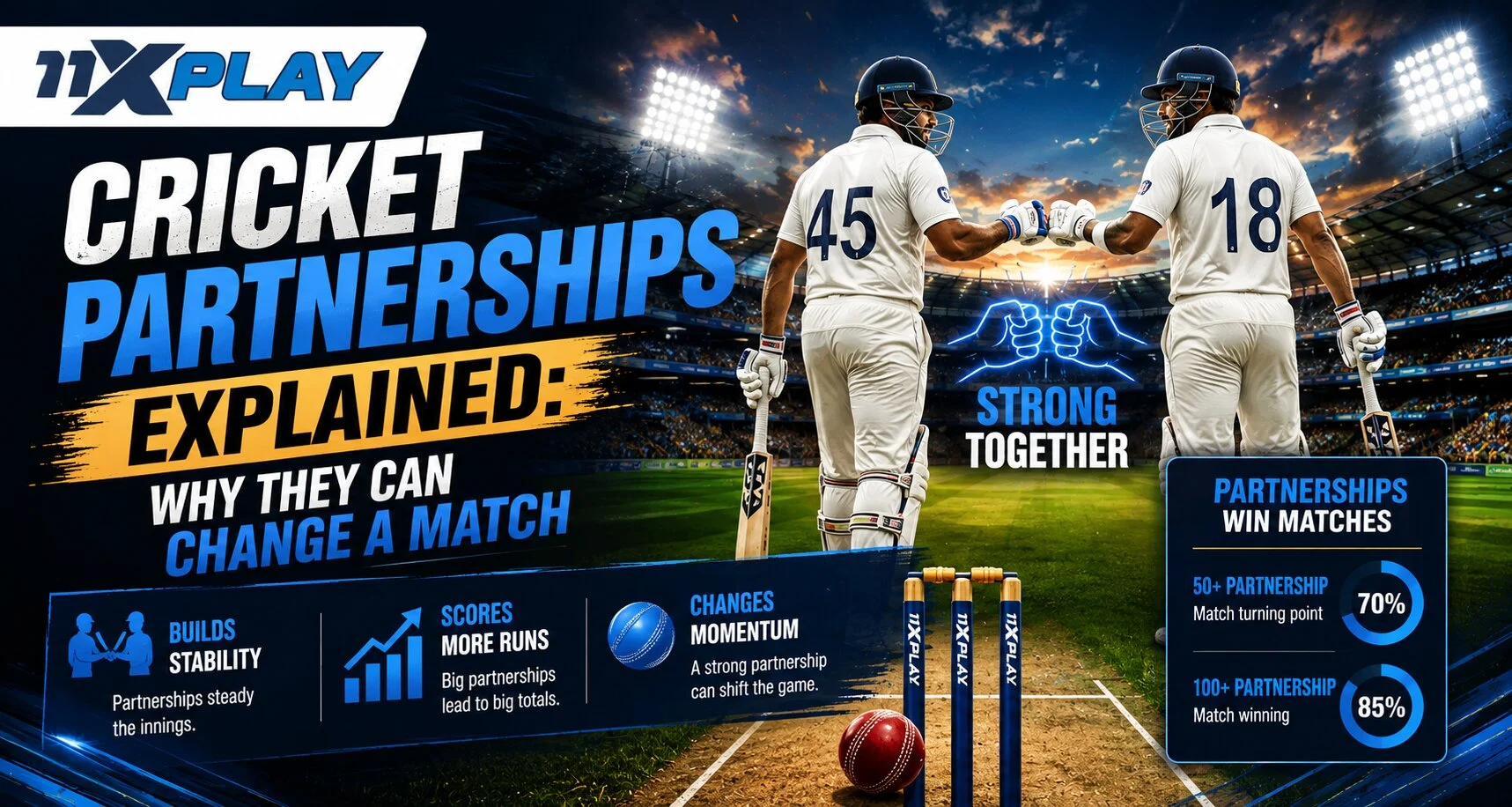
Individual centuries and five-wicket hauls often receive the most attention in cricket, but partnerships between two batters can be equally important. A strong batting partnership can rescue a team from trouble, build a large total or completely change the momentum of a match.
For users learning cricket through platforms such as ,visit 11xplays online id, understanding how partnerships work can make scorecards and match situations much easier to analyse.
This cricket partnerships explained guide looks at what a partnership means, why different partnerships matter and how they affect T20, ODI and Test cricket.
What Is a Partnership in Cricket?
A batting partnership is the number of runs scored while two particular batters are together at the crease.
The partnership begins when a new batter arrives and ends when one of the two players is dismissed, retires or otherwise leaves the innings.
Simple Partnership Example
Imagine a team is 40/2 when the fourth batter arrives.
The score later reaches 140/3.
That means the two batters added a 100-run partnership for the third wicket.
The runs do not need to be shared equally. One batter could score 70 while the other contributes 25, with extras accounting for the remaining five runs.
Why Are Partnerships Important?
Cricket is a team sport, and batting partnerships allow players to work together instead of relying on individual performances.
Partnerships Build Team Totals
Large totals usually require at least one strong partnership.
Even if a batter scores a century, the innings can struggle if wickets continually fall at the opposite end.
A supporting batter can provide stability and allow the stronger scorer to continue building the innings.
Partnerships Stop Bowling Momentum
When a team loses several wickets quickly, the bowling side usually has control.
A solid partnership can stop that momentum.
Two batters who survive difficult overs can force bowlers to change their plans and make the fielding captain search for different options.
Different Types of Batting Partnerships
Not every partnership has the same purpose.
The role depends on the match format and situation.
Opening Partnership
The first-wicket partnership is created by the two opening batters.
Openers normally face the newest ball, which can swing or seam more than an older ball.
A good opening stand can:
- Protect the middle order
- Reduce the impact of the new ball
- Establish a strong scoring platform
- Force bowlers to change their initial plans
In limited-overs cricket, opening partnerships can also take advantage of fielding restrictions.
Middle-Order Partnership
Middle-order partnerships often determine whether a team converts a start into a competitive total.
If early wickets fall, the middle order may need to rebuild.
If the openers perform well, middle-order batters may instead focus on increasing the scoring rate.
Lower-Order Partnership
Lower-order partnerships are sometimes overlooked, but they can be extremely valuable.
A recognised batter batting with a bowler may try to keep most of the strike while still allowing the lower-order player to contribute.
An additional 30 or 40 runs from the final wickets can become decisive in a close match.
How Partnerships Work in T20 Cricket
T20 partnerships are usually shorter because each innings lasts only 20 overs.
However, their impact can still be significant.
Fast Partnerships Can Change the Run Rate
In T20 cricket, a 60-run partnership from 30 balls can be more valuable than a slower partnership of similar size.
Batters need to balance wicket preservation with aggressive scoring.
The strongest T20 partnerships often combine:
- Boundary hitting
- Quick singles
- Good strike rotation
- Smart risk management
One Batter Can Attack While the Other Anchors
Different batting styles can complement each other.
One batter may play aggressively while the other focuses on keeping the partnership together.
This approach can help a team avoid losing several wickets while maintaining a competitive scoring rate also user can manage your account in 11xplays login.
Partnerships in ODI Cricket
ODI cricket gives partnerships more time to develop.
Rebuilding After Early Wickets
If a team loses two or three early wickets, batters may initially focus on reducing risk.
They can rebuild through singles, doubles and controlled boundary hitting before increasing the scoring rate later.
Partnerships During the Middle Overs
Middle-over partnerships are particularly important because teams need to maintain momentum without exposing the lower order too early.
Strong strike rotation can prevent bowlers from controlling this phase.
Partnerships in Test Cricket
Test cricket allows partnerships to develop over long periods.
A successful partnership may last several sessions and involve hundreds of deliveries.
Read Also : Cricket Partnerships Explained: Why They Can Change a Match
Time at the Crease Matters
In Tests, partnerships are not judged only by runs.
The number of balls faced can also be important.
A partnership lasting 30 overs can:
- Tire the bowlers
- Make the ball older
- Reduce movement
- Create better conditions for later batters
Partnerships Can Save Matches
A team does not always need to score quickly in Test cricket.
When trying to draw a match, two batters may focus primarily on survival.
A long defensive partnership can therefore be as valuable as a fast scoring stand in another situation.
How Partnerships Affect Match Momentum
Momentum is difficult to measure precisely, but partnerships clearly influence the direction of a game.
After Quick Wickets
Suppose a team falls from 80/1 to 90/4.
The bowling team has gained control.
If the next two batters then add 120 runs, the balance of the match can completely change.
During a Run Chase
Partnerships are especially important while chasing a target.
Two settled batters can control the required run rate and reduce pressure on players who are still waiting to bat.
How Partnerships Help Cricket Match Analysis
Users studying cricket matches should look beyond individual scores.
The partnership data can reveal how an innings actually developed.
Check Where the Major Stand Occurred
A 150-run opening partnership tells a different story from a 150-run sixth-wicket partnership.
The opening stand suggests early dominance.
A sixth-wicket stand may indicate that the team recovered from serious trouble.
Look at the Partnership Run Rate
The scoring speed also matters.
A 100-run partnership from 70 balls is very different from a 100-run partnership from 200 balls.
The match format determines which approach is more useful.
Consider the Match Situation
Always connect the partnership to the score.
A 50-run partnership when a team is 300/2 may have less influence than a 50-run stand after the team has collapsed to 30/5.
Common Partnership Terms
Understanding scorecards becomes easier when you know common terminology.
Century Partnership
A partnership worth at least 100 runs.
Fifty-Run Partnership
A stand that reaches at least 50 runs.
Unbroken Partnership
A partnership that is still continuing when an innings ends.
Record Partnership
The highest partnership recorded for a particular wicket, team, venue or competition.
Conclusion
Cricket partnerships provide a clearer picture of how an innings develops. They show how batters work together, respond to pressure and build or rescue a team’s total.
From aggressive T20 stands to long Test partnerships, each format requires a different approach. By understanding partnerships alongside wickets, run rates and match conditions, cricket followers using 11xplay can develop a more complete understanding of the game.
FAQs About Cricket Partnerships
What is a batting partnership in cricket?
It is the number of runs added while two specific batters are together at the crease.
When does a partnership end?
It usually ends when one of the two batters is dismissed or leaves the innings.
Are partnerships important in T20 cricket?
Yes. Even short partnerships can have a major impact because T20 matches have limited deliveries.
Why are lower-order partnerships important?
They can add valuable runs after the main batters have been dismissed and sometimes change the final result.
Can extras be included in a partnership?
Yes. Extras scored while the two batters are together contribute to the partnership total.


