
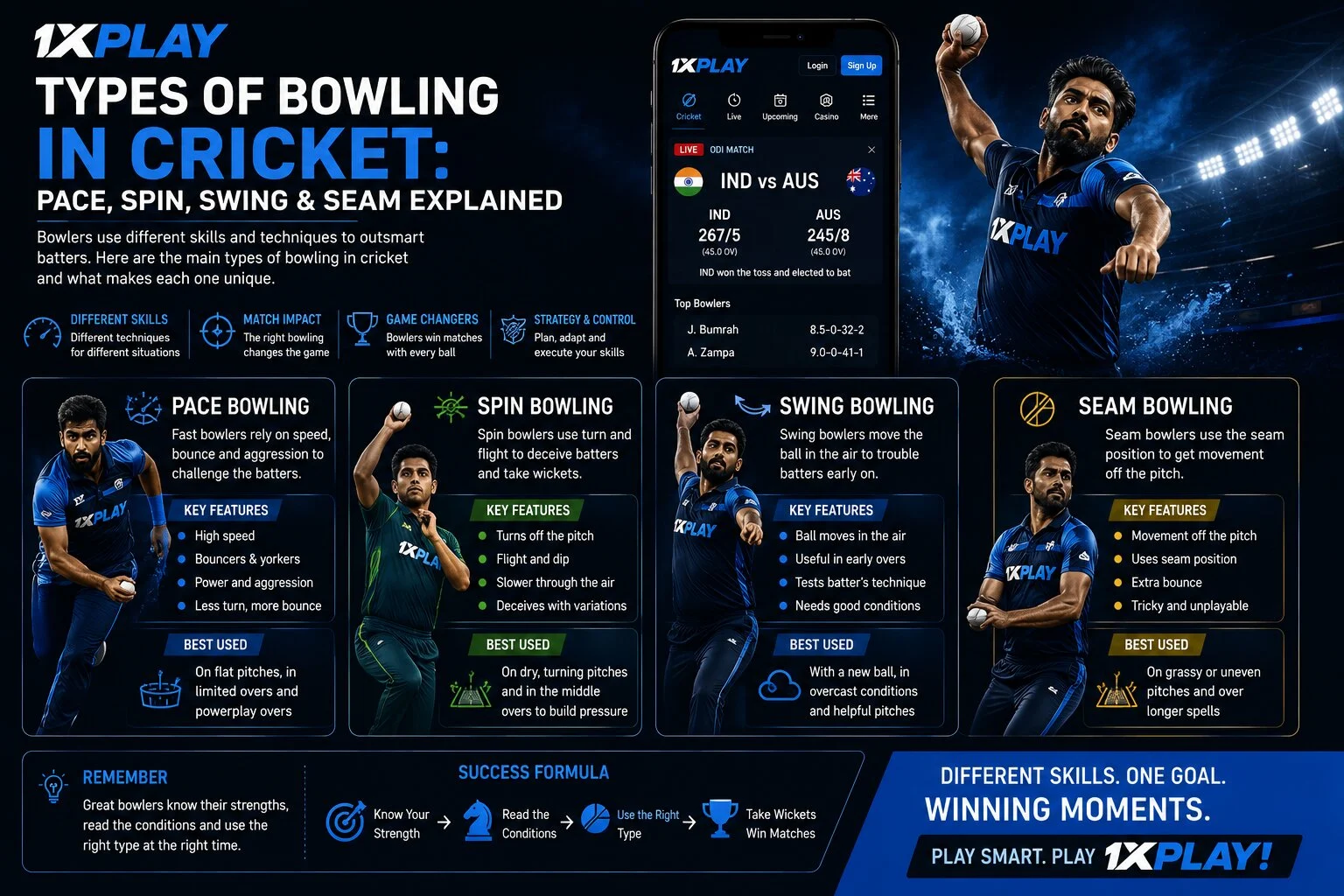
Bowling is one of the most important parts of cricket, and bowlers use a wide variety of techniques to challenge batters.
Some bowlers rely primarily on speed.
Others use movement through the air, movement from the pitch or spin to create difficulty 11xplays cricket id.
Understanding different bowling types helps cricket fans follow tactical decisions and appreciate how conditions influence bowling strategies.
The Two Main Types of Bowling
At the broadest level, cricket bowling can be divided into two major categories:
- Fast or pace bowling
- Spin bowling
Both categories contain several variations.
What Is Fast Bowling?
Fast bowling focuses primarily on pace.
Fast bowlers attempt to make it difficult for batters to react by delivering the ball at high speed.
They may also use:
- Swing
- Seam movement
- Bounce
- Yorkers
- Bouncers
- Slower balls
A fast bowler can therefore use both speed and movement.
What Is Swing Bowling?
Swing bowling occurs when the ball moves through the air after being released.
A bowler may attempt to make the ball move:
- Into the batter
- Away from the batter
The movement can make shot selection more difficult.
Swing can depend on several factors, including:
- Ball condition
- Seam position
- Weather
- Air movement
- Bowling technique
This connects directly with your existing Cricket Pitch Conditions Explained article.
What Is Seam Bowling?
Seam bowling relies on the ball interacting with the pitch after bouncing.
The seam can influence the direction of movement.
A bowler may attempt to land the ball in an area where it can deviate after pitching.
Seam movement can be particularly interesting on pitches offering assistance to fast bowlers.
What Is a Yorker?
A yorker is a delivery aimed close to the batter’s feet, usually near the base of the stumps.
It can be difficult to hit because the batter has limited room to play a conventional shot.
Yorkers are particularly associated with:
- Death overs
- Limited-overs cricket
- Stump-targeting strategies
What Is a Bouncer?
A bouncer is a short-pitched delivery that rises toward the batter after bouncing.
The goal may be to:
- Challenge the batter with bounce
- Restrict shot options
- Force defensive responses
- Create tactical pressure
The laws of cricket contain specific regulations concerning short-pitched deliveries, so exact limits depend on the applicable playing conditions.
What Is a Slower Ball?
A slower ball is delivered at a reduced pace compared with the bowler’s normal delivery.
The purpose is to disrupt the batter’s timing.
It can be particularly effective when a batter expects a faster delivery.
Slower balls are commonly used in limited-overs cricket.
What Is Spin Bowling?
Spin bowling relies on rotation imparted to the ball.
Instead of depending primarily on speed, spin bowlers attempt to make the ball turn after pitching.
The major categories include:
- Off spin
- Leg spin
Other variations include:
- Googly
- Doosra
- Carrom ball
- Arm ball
What Is Off Spin?
An off-spinner generally delivers the ball so that it turns in a particular direction for a conventional right-handed batter.
Off-spin bowling can be used to:
- Control scoring
- Create mistakes
- Build pressure
- Attack weaknesses
The effectiveness of spin depends heavily on the batter’s stance, pitch conditions and delivery quality.
What Is Leg Spin?
Leg spin is another major form of spin bowling.
A leg-spinner generally attempts to make the ball turn significantly after pitching.
Leg-spin bowling can include several variations.
One famous variation is the:
Googly
What Is a Googly?
A googly is a deceptive delivery associated with leg-spin bowling.
It appears similar to a conventional leg-spinner’s delivery but turns in the opposite direction from what the batter may expect.
This element of deception makes the googly an important tactical weapon.
Pace vs Spin Bowling
| Feature | Pace Bowling | Spin Bowling |
| Main weapon | Speed | Rotation |
| Movement | Air/pitch | Pitch |
| Typical pace | Faster | Slower |
| Bounce | Often important | Can vary |
| Variations | Yorker, bouncer, slower ball | Googly, doosra, arm ball |
| Conditions | Seam/swing can matter | Surface grip can matter |
This is a simplified comparison because modern bowlers often combine multiple skills.
How Pitch Conditions Affect Bowling
Pitch conditions can influence bowling effectiveness.
A surface offering movement may help seam bowlers.
A dry or worn surface may provide opportunities for spin.
However, there is no universal rule that one type of pitch always guarantees success for a particular bowling style.
Conditions should be assessed together with:
- Weather
- Ball condition
- Match format
- Bowler skill
- Batter technique
Bowling in T20 Cricket
T20 cricket has created a particularly large range of bowling variations.
Bowlers often use:
- Yorkers
- Slower balls
- Wide lines
- Short balls
- Pace changes
- Spin variations
Because batters are attempting to score quickly, bowlers often try to disrupt timing and restrict boundary opportunities.
Your existing Cricket Powerplay Explained article can be used here to explain how field restrictions influence early-innings tactics.
Bowling in Test Cricket
Test cricket provides a different tactical environment.
Fast bowlers can use:
- Swing
- Seam
- Bounce
- Reverse swing
Spin bowlers can become increasingly important as pitch conditions change.
Because Test matches can last several days, bowling strategy may evolve throughout the match.
Bowling Economy Rate
Economy rate measures how many runs a bowler concedes per over.
The basic formula is:
Economy Rate = Runs Conceded ÷ Overs Bowled
For example:
A bowler concedes:
30 runs
in:
5 overs
Economy rate:
30 ÷ 5 = 6.00
Your existing Cricket Strike Rate and Economy Rate Explained article is the natural internal link for this topic.
Bowling Strike Rate
Bowling strike rate describes the average number of deliveries required for a bowler to take a wicket.
A simplified formula is:
Bowling Strike Rate = Balls Bowled ÷ Wickets Taken
For example:
120 balls and 4 wickets:
120 ÷ 4 = 30
Bowling strike rate:
30 balls per wicket
Why Bowling Variations Matter
Modern cricket is highly tactical.
A bowler may change:
- Length
- Speed
- Line
- Angle
- Seam position
- Release point
depending on the batter and match situation.
This is why simply categorizing a bowler as “fast” or “spin” does not tell the entire story also user can manage your account in 11xplays login.
Final Thoughts
Cricket bowling includes a wide range of techniques, from high-speed pace bowling to subtle spin variations.
Understanding swing, seam, yorkers, bouncers, slower balls and spin helps fans understand the tactical side of cricket.
Bowling should also be viewed in the context of pitch conditions, match format, field settings and the batter at the crease.
Frequently Asked Questions
What are the main types of bowling in cricket?
The two broad categories are pace bowling and spin bowling.
What is swing bowling?
Swing bowling involves movement of the ball through the air.
What is seam bowling?
Seam bowling attempts to use the seam and pitch surface to create movement after the ball bounces.
What is a yorker?
A yorker is a delivery aimed close to the batter’s feet and the base of the stumps.
What is a bouncer?
A bouncer is a short-pitched delivery that rises toward the batter after bouncing.
What is spin bowling?
Spin bowling relies on rotation imparted to the ball to create movement after pitching.
What is a googly?
A googly is a leg-spin variation designed to turn in the opposite direction from what the batter may expect.


