
Introduction
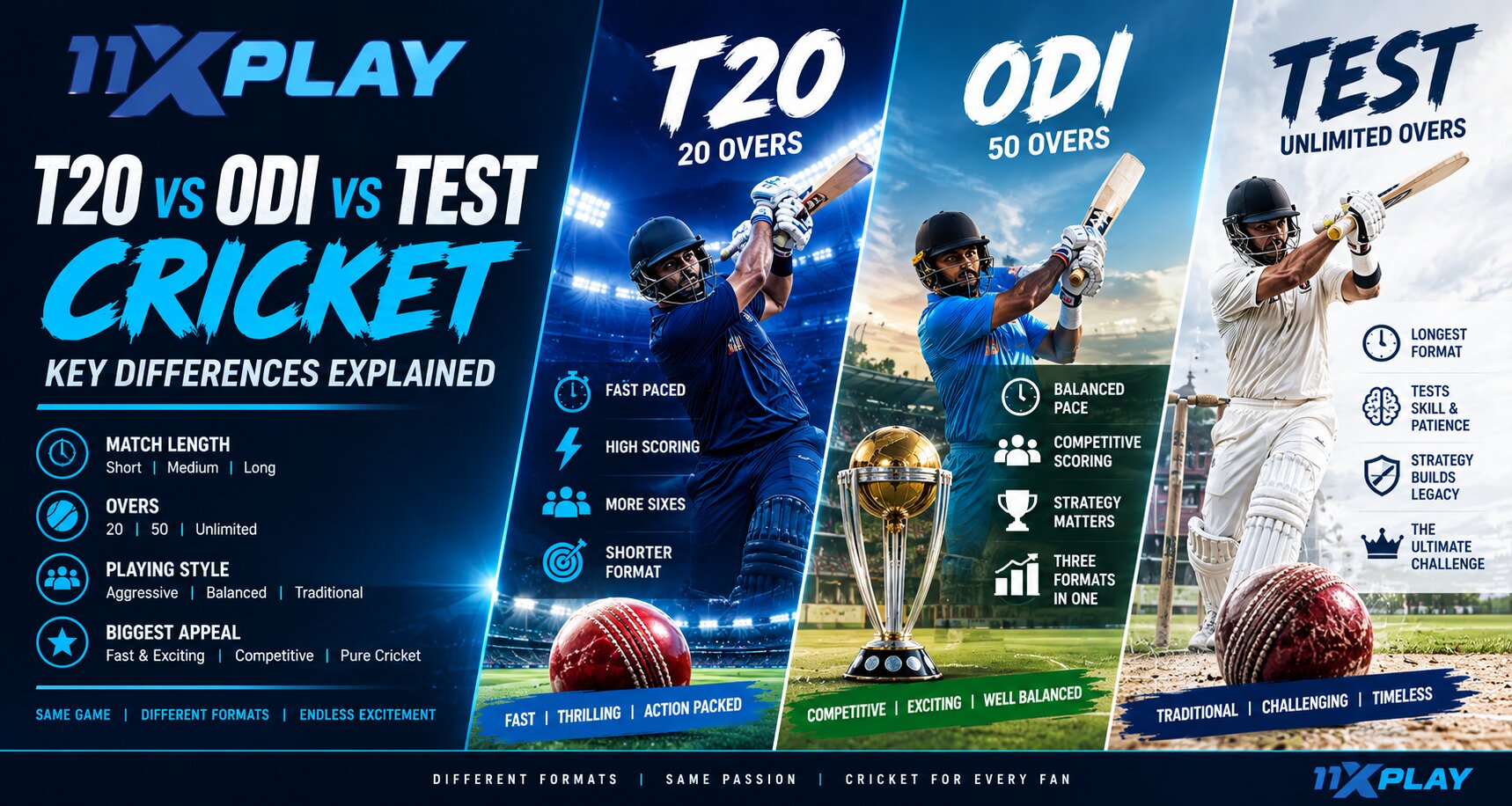
Cricket is played in several formats, but the three most widely recognised international formats are:
- T20 cricket
- One Day International cricket
- Test cricket
Although all three formats use the same basic principles of batting, bowling and fielding, they create very different tactical environments.
A T20 match can change dramatically within a few deliveries. An ODI provides teams with more time to build and recover an innings. Test cricket can develop over several days, requiring patience, endurance and long-term strategy ,visit 11xplays.
Understanding these differences is useful for anyone who wants to follow cricket more closely, analyse match performances or understand how different cricket markets work.
What Is T20 Cricket?
T20 stands for Twenty20.
Each team normally receives a maximum of 20 overs to bat.
The limited number of overs creates a fast-paced format in which teams generally have to score quickly.
A T20 match is normally completed within a few hours, making it much shorter than an ODI or Test match.
Because every over represents a significant percentage of the innings, individual moments can have a major impact on the result.
What Is ODI Cricket?
ODI stands for One Day International.
Each team normally receives up to 50 overs.
This gives teams considerably more time to build an innings than T20 cricket.
An ODI often involves several distinct phases:
- Opening powerplay
- Middle overs
- Final overs
Teams need to balance scoring quickly with preserving wickets.
An early collapse does not necessarily end an innings because there are many overs remaining.
What Is Test Cricket?
Test cricket is the longest traditional international format.
A Test match can last up to five days, subject to playing conditions and interruptions.
Unlike T20 and ODI cricket, there is no fixed 20- or 50-over limit for an innings.
A team can potentially bat for a long period if it avoids losing all of its wickets.
Test cricket therefore places greater emphasis on:
- Batting technique
- Patience
- Bowling endurance
- Session-by-session strategy
- Pitch deterioration
- Time management
T20 vs ODI vs Test: Quick Comparison
| Feature | T20 | ODI | Test |
| Overs per innings | Up to 20 | Up to 50 | No fixed over limit |
| Typical duration | Several hours | Around a day | Up to five days |
| Innings per team | Usually 1 | Usually 1 | Usually 2 |
| Scoring pace | High | Moderate to high | Variable |
| Main emphasis | Aggression and speed | Balance and adaptability | Technique and endurance |
| Powerplay concept | Yes | Yes | No equivalent limited-overs powerplay |
| Draw possible | Generally no | Generally no | Yes |
| Strategic depth | High | High | Very high |
Main Difference: Time Available
The biggest difference between the three formats is the amount of time available.
A T20 team has only 20 overs.
An ODI team has 50 overs.
A Test team can bat for much longer, subject to wickets, match conditions and time.
This changes how teams approach risk.
A T20 batter may need to attack immediately because there are limited opportunities to recover later.
An ODI batter can spend more time building an innings.
A Test batter may spend an extended period defending before increasing the scoring rate also user can manage your account in 11xplays login.
T20 Cricket Strategy
T20 cricket is heavily influenced by scoring rate.
Teams generally want to maximise the number of runs scored during a limited number of deliveries.
Important elements include:
- Powerplay scoring
- Boundary hitting
- Strike rotation
- Wicket preservation
- Matchups
- Death-over scoring
Batters often use aggressive shots because the value of scoring quickly is high.
Bowlers also use variations such as:
- Slower balls
- Yorkers
- Wide lines
- Changes of pace
The objective is to restrict boundaries while creating wicket opportunities.
Read Also : 11xplay Download Management Guide: Understanding Browser Downloads
ODI Cricket Strategy
ODI cricket requires a more balanced approach.
The innings can be divided into different tactical phases.
Early Overs
Batters can take advantage of fielding restrictions but must also manage the risk of losing wickets.
Middle Overs
The focus often shifts towards:
- Strike rotation
- Partnerships
- Building pressure
- Managing wickets
- Attacking favourable matchups
Final Overs
The scoring rate often increases again as teams attempt to maximise the final overs.
This creates a balance between preservation and aggression that is different from T20 cricket.
Test Cricket Strategy
Test cricket requires a completely different mindset.
A batter may spend a significant amount of time simply surviving.
The objective is not always to score as quickly as possible.
A batter may instead focus on:
- Leaving difficult deliveries
- Defending carefully
- Building partnerships
- Managing fatigue
- Waiting for scoring opportunities
For bowlers, maintaining pressure over long spells can be more important than producing immediate breakthroughs.
Differences in Scoring Rate
T20 generally has the highest scoring rate of the three formats.
The reason is straightforward: teams have fewer overs and need to maximise their scoring opportunities.
ODI scoring rates can also be high but are usually more balanced.
Test cricket can have significantly different scoring rates depending on the pitch, players, match situation and stage of the game.
A slow scoring rate in Test cricket is not necessarily a sign of poor performance.
Context matters.
Role of the Powerplay
Powerplays are particularly important in limited-overs cricket.
In T20 cricket, the opening powerplay covers the first six overs.
ODI cricket also has fielding restrictions during specific phases of the innings.
These restrictions encourage attacking cricket by limiting how many fielders can be positioned outside the designated inner area.
Test cricket does not use the same limited-overs powerplay structure.
Instead, field placements are generally determined according to the match situation and the laws and playing conditions of Test cricket.
For more information, see our article:
Cricket Powerplay Explained: Rules, Overs and Strategy
Importance of Wickets
Wickets have different strategic values across the formats.
In T20 cricket, losing several wickets quickly can make it difficult to maintain the required scoring rate.
In ODI cricket, a team can sometimes recover from early wickets because more overs remain.
In Test cricket, wickets are even more valuable because each side generally has two innings and batting depth can influence how long a team can occupy the crease.
Importance of Pitch Conditions
Pitch conditions can influence all three formats, but their impact can develop differently.
In T20 cricket, the match may finish before significant pitch deterioration occurs.
In ODI cricket, the surface can change during the course of the match.
In Test cricket, pitch behaviour can evolve substantially over several days.
A surface may become:
- Slower
- More difficult to bat on
- More helpful to spin
- More unpredictable
This is one reason Test match strategy can change significantly from one day to another.
Weather and Match Format
Weather can influence all forms of cricket.
In T20 and ODI cricket, rain interruptions can reduce the number of overs available.
In Test cricket, rain can remove entire sessions or days from the match.
This can significantly change the probability of a result.
For example, a team that is in a strong position may lose valuable time because of rain, increasing the possibility of a draw.
T20 vs ODI vs Test: Batting Approach
T20
Primary focus:
Scoring quickly
Batters generally need to maximise the limited number of deliveries.
ODI
Primary focus:
Balancing scoring and wicket preservation
Batters have more time to build an innings.
Test
Primary focus:
Building an innings and managing risk
Batters can spend considerable time establishing themselves at the crease.
T20 vs ODI vs Test: Bowling Approach
T20 Bowling
Bowlers often rely heavily on variation and defensive tactics.
The goal is to prevent boundaries and create mistakes.
ODI Bowling
Bowlers can use different phases of the innings strategically.
Opening bowlers may attack with the new ball, while spinners can become important during the middle overs.
Test Bowling
Bowlers have a much larger strategic canvas.
They can build pressure over long spells and attack different weaknesses over time.
Which Format Is the Fastest?
T20 cricket is the fastest of the three formats.
With only 20 overs per side, the game moves rapidly and momentum can change within a few deliveries.
Which Format Requires the Most Patience?
Test cricket generally requires the greatest amount of patience.
Players must manage physical and mental demands over several days.
Batters may need to defend for long periods, while bowlers need to maintain accuracy and intensity over extended spells.
Which Format Has the Most Tactical Phases?
All three formats involve tactical planning, but Test cricket generally offers the longest strategic timeline.
T20 strategy can change from over to over.
ODI strategy develops across three major innings phases.
Test strategy can evolve across sessions, days and multiple innings.
How the Formats Affect Cricket Markets
The format of a match can also influence the types of markets available and the way they behave.
T20 matches may feature strong interest in markets related to:
- Match winner
- Powerplay
- Team totals
- Player performance
- Sixes
- Boundaries
ODI markets can include:
- Match winner
- Innings totals
- Top batter
- Top bowler
- Partnerships
- Run-related markets
Test cricket can involve markets related to:
- Match result
- Draw
- First innings lead
- Session performance
- Player performance
- Wickets
The exact markets depend on the competition and platform.
For a broader explanation, see:
Popular Cricket Markets for T20, ODI & Test Matches
Final Thoughts
T20, ODI and Test cricket share the same basic sport but create very different competitive environments.
T20 is fast, aggressive and heavily influenced by short bursts of performance.
ODI combines aggression with longer-term innings management.
Test cricket places greater emphasis on technique, patience, endurance and multi-day strategy.
Understanding these differences can make it easier to follow match statistics, team performances and cricket markets.
Frequently Asked Questions
What is the difference between T20 and ODI cricket?
T20 gives each team up to 20 overs, while ODI cricket generally provides up to 50 overs per team.
How long can a Test match last?
A Test match can be scheduled for up to five days, although the final duration can be affected by weather, results and other match conditions.
Which cricket format is the fastest?
T20 cricket is the fastest format because each team has only 20 overs.
Can a Test match end in a draw?
Yes. A Test match can end in a draw if neither side wins within the available playing time.
Does Test cricket have powerplays?
Test cricket does not use the same limited-overs powerplay system used in T20 and ODI cricket.
Why is T20 cricket more aggressive?
With only 20 overs available, teams have less time to accumulate runs, encouraging a higher scoring rate and more aggressive batting.
Final Thoughts
T20, ODI and Test cricket share the same basic sport but create very different competitive environments.
T20 is fast, aggressive and heavily influenced by short bursts of performance.
ODI combines aggression with longer-term innings management.
Test cricket places greater emphasis on technique, patience, endurance and multi-day strategy.
Understanding these differences can make it easier to follow match statistics, team performances and cricket markets.


