
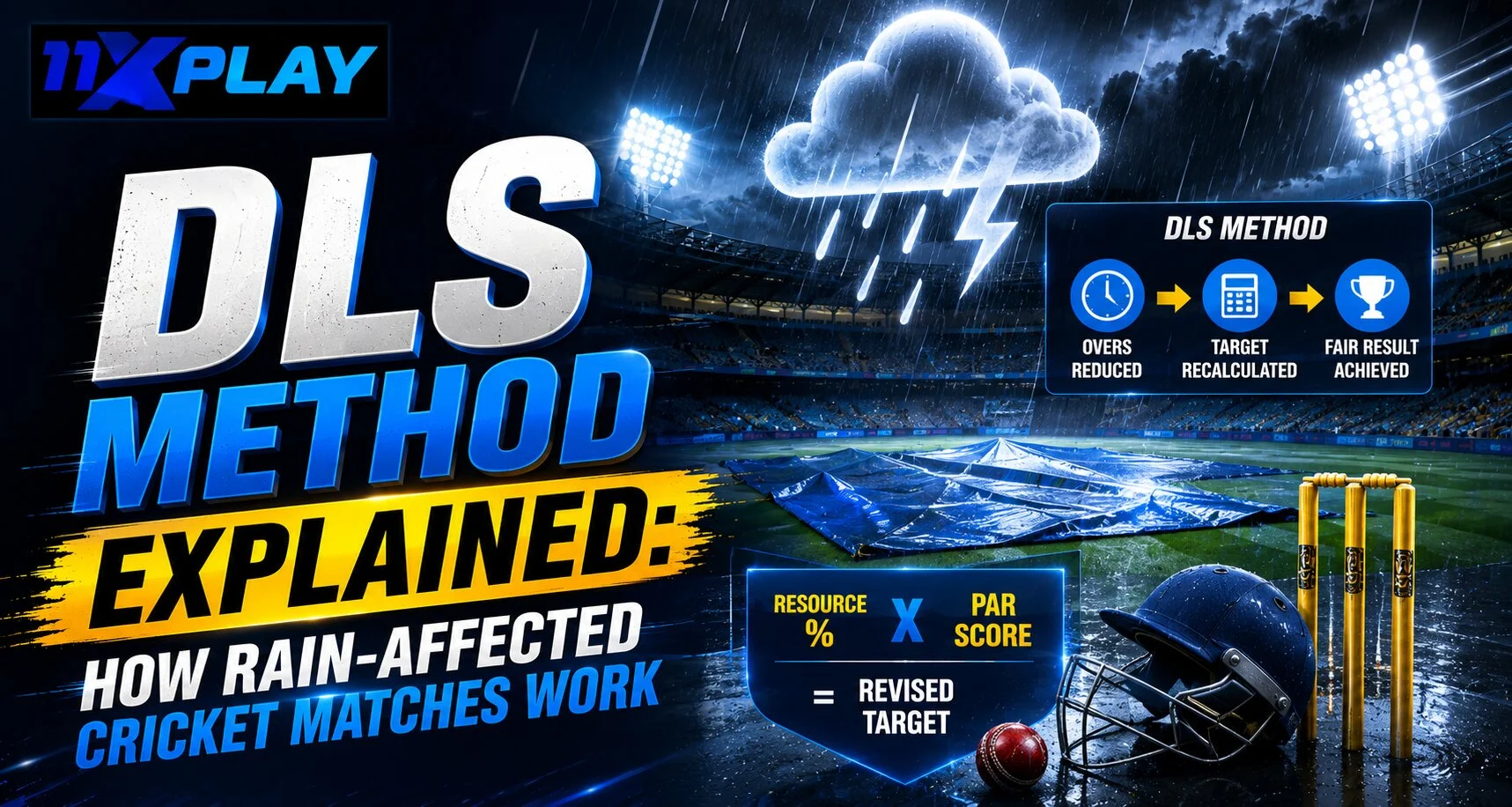
Rain can completely change the structure of a limited-overs cricket match.
If an innings loses overs because of rain or another interruption, teams may no longer have the same number of scoring opportunities.
To deal with this situation, limited-overs cricket uses a mathematical system known as the Duckworth-Lewis-Stern method, commonly shortened to DLS ,visit 11xplays online id.
The system is used to calculate revised targets or par scores in appropriate rain-affected matches.
What Does DLS Stand For?
DLS stands for Duckworth-Lewis-Stern.
The method developed from the earlier Duckworth-Lewis system and is used in international and domestic limited-overs cricket under applicable playing conditions.
Its purpose is to create a revised target that reflects the resources available to the teams after an interruption.
Why Is DLS Needed?
Imagine a T20 match where Team A bats first and scores 180 from its 20 overs.
Team B begins its chase but rain stops play after only five overs.
If Team B loses 10 overs from its innings, it cannot reasonably be expected to chase the original target using the same number of deliveries available to Team A.
A revised target may therefore be required.
The DLS method provides the framework for determining that revised target.
What Does DLS Consider?
DLS is based primarily on the concept of resources.
For a limited-overs team, resources are broadly represented by:
- Overs remaining
- Wickets remaining
A team with many overs and wickets available has more resources than a team with only a few overs or wickets remaining.
Rain can reduce the number of overs available, thereby reducing the batting resources.
Why Are Wickets Important?
Wickets are an important component because a team with more wickets available has greater freedom to take risks.
Consider two teams with the same number of overs remaining.
Team A has lost only one wicket.
Team B has lost eight wickets.
They do not have the same batting resources.
Team A has much greater flexibility to attack.
Team B has considerably less batting depth available.
DLS accounts for these differences also user can manage your account in 11xplays login.
How Does DLS Change a Target?
A revised target depends on the original match situation and the resources available after the interruption.
It is not simply:
Original target ÷ number of overs
Instead, the calculation is based on the DLS resource model.
This is important because a team’s ability to score is not perfectly proportional to the number of overs remaining.
For example, losing five overs at the beginning of an innings can have a different effect from losing five overs near the end.
Why Doesn’t DLS Simply Reduce the Target Proportionally?
Cricket scoring is not linear.
A team with 20 overs remaining does not necessarily have exactly twice the scoring potential of a team with 10 overs remaining.
The value of wickets also changes depending on how many overs remain.
A team with ten wickets and ten overs remaining is in a different position from a team with three wickets and ten overs remaining.
The DLS model attempts to account for these relationships.
DLS in T20 Cricket
DLS can be particularly important in T20 cricket because losing several overs represents a significant percentage of the innings.
For example, reducing a T20 innings from 20 overs to 10 overs cuts the available deliveries by half.
This can fundamentally change:
- Required scoring rate
- Batting strategy
- Bowling strategy
- Value of wickets
- Match result
The exact revised target depends on the match situation and applicable DLS calculations.
DLS in ODI Cricket
DLS is also used in rain-affected ODI matches where the number of overs available to one or both teams is reduced.
Because an ODI innings normally has up to 50 overs, the effect of an interruption can vary significantly depending on when it occurs.
A short interruption may have a relatively small effect.
A long interruption can dramatically alter the structure of the match.
What Is a Par Score?
In a rain-affected match, you may hear commentators refer to a par score.
A par score represents the score that corresponds to a particular resource position under the applicable DLS calculation.
It can help determine which team is ahead when an innings is interrupted or cannot continue.
The exact interpretation depends on the match situation and competition rules.
What Happens If Rain Stops a Chase?
Suppose Team A bats first and establishes a target.
Team B starts chasing.
Rain then interrupts the match.
If play resumes with fewer overs available, the target may be revised.
The new target is designed to reflect Team B’s reduced resources.
This prevents the chasing side from being required to achieve a target that was based on having more overs available than it actually receives.
What If Rain Stops the First Innings?
Rain can also affect the team batting first.
If the first innings loses overs, the team may receive a reduced number of overs in which to score.
The second innings target is then determined according to the applicable rules and resource calculations.
This is why rain can affect both teams rather than simply making the chasing team face a smaller target.
Why Does DLS Sometimes Seem Complicated?
The system is mathematical and takes multiple variables into account.
A casual viewer might expect a simple calculation such as:
Runs required ÷ overs remaining
But DLS considers the relationship between:
- Overs
- Wickets
- Batting resources
- Stage of innings
This makes it more sophisticated than simply reducing a target by a fixed percentage.
Example of Why DLS Matters
Consider a hypothetical ODI.
Team A scores:
250 runs from 50 overs
Team B starts its innings.
After 20 overs, Team B has:
95/2
Rain then interrupts play.
Suppose the match can resume but only 15 overs remain.
Team B cannot simply be told to chase the original 251-run target from 15 overs.
The available batting resources have changed.
A revised target can therefore be calculated under the applicable DLS rules.
The exact number should come from the official calculation rather than a simplified manual estimate.
DLS and Required Run Rate
DLS can substantially change the required run rate.
For example, a team may initially require:
7 runs per over
before an interruption.
After a substantial reduction in overs, its revised target may require a significantly higher scoring rate.
This can encourage a much more aggressive approach.
The batting team may need to accept greater risk because there are fewer deliveries available.
DLS and Wickets
Wickets become particularly important when a rain interruption occurs.
A team with more wickets in hand may have more resources remaining.
A team that has already lost several wickets may have fewer resources available even if the number of overs remaining is identical.
This is one of the reasons DLS is more complex than an overs-only calculation.
Can DLS Guarantee a Fair Result?
No mathematical method can perfectly recreate the conditions of a full match.
DLS is designed to provide a structured method for adjusting targets when playing time is lost.
It aims to produce a reasonable and consistent result based on available batting resources.
The actual outcome can still be influenced by unpredictable cricket events.
Common DLS Misunderstandings
“DLS Just Cuts the Target”
Not exactly.
DLS uses a resource-based calculation rather than simply reducing the target by a fixed percentage.
“Only Overs Matter”
No.
Wickets are also an important component of the resource model.
“The Team Chasing Always Benefits”
Not necessarily.
Rain can affect either innings and can change the strategic situation for both teams.
“DLS Is Only Used in ODI Cricket”
No.
It can also be relevant to T20 and other limited-overs competitions when the applicable playing conditions provide for it.
Read Also : 11xPlay Cricket Data Guide: Understanding Match Statistics
Frequently Asked Questions
What is DLS in cricket?
DLS stands for Duckworth-Lewis-Stern and is a method used to adjust targets or determine par scores in appropriate rain-affected limited-overs matches.
Why does cricket use DLS?
It helps adjust a match when rain or another interruption reduces the number of overs available.
Does DLS consider wickets?
Yes. The method is based on batting resources, which include both overs and wickets.
Can DLS be used in T20 cricket?
Yes, where the competition’s playing conditions provide for it.
Does DLS reduce the target by a fixed percentage?
No. The resource-based calculation is more complex than a simple percentage reduction.
What is a DLS par score?
It is a score used within the DLS framework to indicate the expected position of a team given the resources available at a particular point.
Final Thoughts
The DLS method is an important part of modern limited-overs cricket.
It exists because rain can remove scoring opportunities and make the original target inappropriate.
By considering overs and wickets as batting resources, DLS provides a structured method for revising targets and assessing match situations.
For cricket fans, understanding the basic idea is more important than memorising the mathematical tables behind the system.


